
-
Shop by category
Explore all dealsExplore this collection for more finds.
View this find
- Amazon Best Sellers
- Under $25
-
Shop by brand
View all brandsExplore this collection for more finds.
View this find
-
eDeals & offers
Explore all dealsExplore this collection for more finds.
View this find
- Shopping guides
- Compare products Free tool
-
Shop by category
Explore all dealsExplore this collection for more finds.
View this find
- Amazon Best Sellers
- Under $25
-
Shop by brand
View all brandsExplore this collection for more finds.
View this find
-
eDeals & offers
Explore all dealsExplore this collection for more finds.
View this find
- Shopping guides
- Compare products Free tool
THE EVERYDAY EDITKitchen & Dining
How to Coordinate a Shared Dish-Drying Station
A practical household routine for agreeing when dishes are ready, loading around the next person’s needs, giving small items a default place, and making rack clearing someone’s clear next step.
Explore the picks
In a shared kitchen, a drying rack can turn into a guessing game: Is that mug ready to put away? Will moving those plates block someone else’s bowl? Who is supposed to clear the counter? A short household agreement can answer those questions without expecting everyone to read the dishes—or guess each other’s plans. Work through these steps together, then adjust the rules to suit the way your household uses the kitchen.
Ad · We may earn a commission. As an Amazon Associate I earn from qualifying purchases.
1. Agree on what “still drying” means
Choose a rule people can follow without guessing from how a dish looks. For example, agree that whoever loads a mug checks it again after the next meal. If it is still wet, it stays on the rack rather than being stacked away. The useful part is the shared decision point—not a promise that every item will be dry by a certain time. If someone needs that mug sooner, they can choose another or ask the person who loaded it.
2. Load for the next person who needs something
Before placing a dish, consider what someone else will need to lift out next. If a household member needs a bowl for breakfast, give it a spot they can reach without shifting a row of plates. Less urgent dishes can go behind it. This makes the order of loading a small act of coordination: the first person to wash does not automatically get the easiest access, and the next user is less likely to disturb everything to retrieve one item.
3. Give small items a shared default place
Pick a simple convention for utensils and other small washed items, then use it consistently. For example, assign teaspoons to one compartment of a divided cutlery holder and other small items to the other. The point is not to imply that the compartments are labeled; the household supplies the meaning. On a rack such as the Kitsure example, whose described parts include a two-space cutlery holder, that agreement gives everyone a common reference instead of leaving small items loose on the counter.
4. Make clearing a handoff, not a vague chore
Tie the check to a moment people already recognize. At the end of dinner, the person loading the last dishes can say whether the rack is full. The next person who has a moment checks whether earlier items are dry and puts away only those ready. That leaves wet dishes undisturbed while creating a clear next step. If the rack is not full, there is no need to treat it as an urgent reset; the agreement is about ownership of the check, not racing to an empty counter.
5. Keep the agreement easy to remember
Try the routine for a few days, then change only the part that causes a recurring snag. If people keep moving plates to reach a bowl, revise the loading rule; if small items collect loose on the counter, clarify the compartment convention. A Kitsure rack is described as including a dish rack, drainboard, and divided cutlery holder, so those parts can serve as reference points for the conversation. They do not identify who loaded dishes or whether they are dry—the household agreement handles that.
Before you decide
- Choose a shared cue for checking whether dishes are ready.
- Keep soon-needed dishes accessible.
- Agree which small items go in each holder space.
- Name the moment and person responsible for the next rack check.
- Adjust the rule that causes repeated confusion.
A relevant item to explore
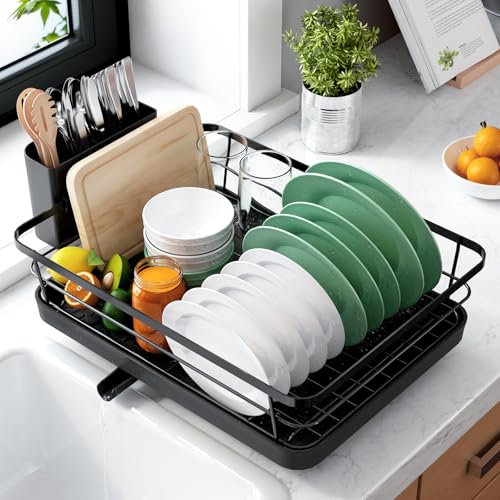
Kitsure Dish Drying Rack for Kitchen Counter, 12''W x 15.5''L, Black
The Kitsure product information describes a countertop dish rack with a drainboard and a cutlery holder divided into two spaces. These stated components provide concrete reference points for a shared loading and small-item agreement; the product is not described as tracking drying status or assigning household responsibilities.
View the exact item and current retailer offer →
Check the exact variant, seller, included pieces, care instructions and current terms. Purchases and checkout take place with the retailer.
Common questions
Where should we keep the agreement so everyone can find it?
Put the short version somewhere household members already look, such as a shared kitchen note or household message. Keep it to the agreed cue, small-item convention, and clearing handoff so it is quick to consult.
What if our household schedule changes?
Revisit the handoff trigger rather than rebuilding the whole routine. If dinner is no longer the moment everyone shares, choose another reliable point in the day when someone can check the rack.
Explore this subject
Prepared by Biz E-Deals using product listing information and general shopping considerations. We have not personally tested the item. Listing information can change; confirm details with the retailer.
Lifestyle context photo: Photo by Douglas Fehr on Unsplash. The pictured setting and items illustrate the topic; exact featured products are shown separately in this guide.
Your next useful read
Explore shopping guides →
Kitchen & Dining
A Smoother Baking Prep Station: Keep Scoops and Ingredients Together
A small change to where baking ingredients and measuring tools live can make recipe prep easier to resume. Build a dedicated baking zone, check how...
Read the guide
Kitchen & Dining
Leftover Storage Mistakes: Make Put-Away Easier to Repeat
A practical mistake-and-correction guide to staging, filling, identifying, and returning food-storage containers without turning leftover cleanup i...
Read the guideThe Biz E-Deals edit
Good finds. A little less searching.
Choose your email topics, start with our welcome guide, and join the list for upcoming curated editions.
Savings explained
More to discover
Choose my emails
Choose your email topics on the next page, then confirm in your inbox. Free and optional. No account needed. Privacy policy